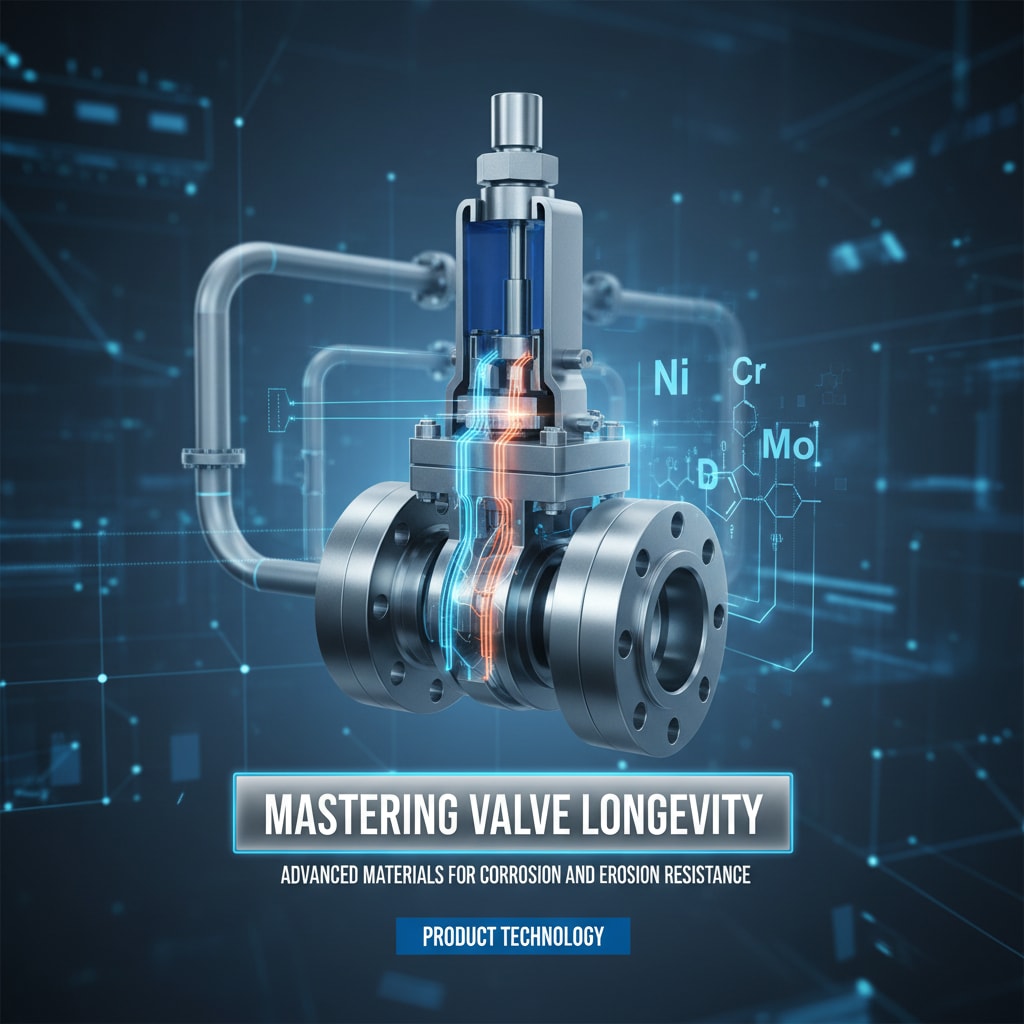
Introduction: The Criticality of Material Selection in Industrial Valves
Industrial valves are the workhorses of process control, operating under immense stress from pressure, temperature, and aggressive media. The primary threats to valve longevity and performance are corrosion and erosion. Premature valve failure due to material degradation leads to costly downtime, maintenance overheads, and potential safety hazards. Selecting the correct material is not merely a purchasing decision; it is a fundamental engineering requirement that dictates the Mean Time Between Failures (MTBF) and overall system reliability.
Materials science offers sophisticated solutions to combat these destructive forces. This comprehensive guide delves into the advanced materials—from specialized alloys to cutting-edge ceramics and polymers—that are essential for extending valve life in the most demanding applications, such as chemical processing, oil and gas, mining, and power generation.
Understanding the Dual Threat: Corrosion and Erosion
To effectively select materials, we must first distinguish between the two primary modes of degradation:
Corrosion
Corrosion is a physiochemical reaction between the valve material and its environment, typically involving oxidation or chemical attack. Common types include pitting corrosion (localized holes), crevice corrosion (in tight spaces), stress corrosion cracking (SCC), and general uniform corrosion.
Erosion
Erosion is the mechanical removal of material from the valve surface, usually caused by high-velocity fluids, abrasive slurries, or cavitation (the rapid formation and collapse of vapor bubbles). Erosion is particularly damaging in control valves and choke valves where high differential pressures accelerate fluid velocity.
In many real-world scenarios, valves face Erosion-Corrosion, a synergistic attack where mechanical wear removes protective oxide layers, exposing fresh material to accelerated chemical degradation.
Section 1: High-Performance Alloys for Chemical Resistance
While carbon steel and standard stainless steels (304/316) suffice for mild services, highly corrosive applications require nickel-based and specialty stainless alloys. These materials achieve superior resistance by forming stable, passive oxide layers that resist chemical attack.
Nickel-Based Alloys (Hastelloy, Inconel, Monel)
Nickel alloys are the industry standard for extreme chemical environments. Hastelloy (various grades, e.g., C-276, B-3) offers exceptional resistance to both oxidizing and reducing acids, chlorides, and wet chlorine gas. Inconel (e.g., 625) provides high strength and excellent resistance to high-temperature oxidation and pitting, making it ideal for sour gas service (H2S) and high-pressure steam.
- Application Focus: Chemical processing reactors, sulfuric acid plants, and high-temperature furnace applications.
Duplex and Super Duplex Stainless Steels (DSS/SDSS)
Duplex stainless steels (e.g., 2205, 2507) feature a mixed microstructure of austenite and ferrite. This structure provides significantly higher yield strength and superior resistance to chloride stress corrosion cracking (CSCC) and pitting compared to standard austenitic stainless steels (like 316L). Super Duplex (SDSS) is often specified for offshore oil and gas platforms where high chloride content seawater is present.
- Application Focus: Seawater cooling systems, desalination plants, and offshore piping.
Section 2: Hard Coatings and Surface Treatments for Erosion Control
When the primary threat is mechanical wear, surface engineering techniques are employed to harden critical components like valve trims, seats, and balls. These treatments increase surface hardness without requiring the entire valve body to be made from expensive, difficult-to-machine materials.
Thermal Spray Coatings (HVOF and Plasma Spray)
High-Velocity Oxygen Fuel (HVOF) and Plasma Spray processes apply extremely dense, hard coatings, often tungsten carbide or chromium carbide, to critical flow surfaces. HVOF, in particular, produces coatings with minimal porosity and exceptional bond strength, making them highly effective against solid particle erosion in abrasive slurries.
Hardfacing and Stellite
Hardfacing, typically using cobalt-chromium alloys (Stellite), involves welding a wear-resistant layer onto the base metal. Stellite is highly effective in high-temperature, high-pressure steam service and where galling (adhesive wear) is a concern, such as in globe valve plugs and seats.
Advanced Surface Treatments (Nitriding and Boriding)
These thermochemical treatments diffuse elements like nitrogen or boron into the surface of the steel, creating a hard, wear-resistant case layer. They are cost-effective methods for improving the erosion resistance of components not exposed to extreme chemical attack.
Section 3: Ceramics and Polymers: Specialized Solutions
For applications where traditional metals fail, non-metallic materials offer unique advantages in both chemical inertness and extreme wear resistance.
Engineered Ceramics
Materials like Zirconia (ZrO₂), Alumina (Al₂O₃), and Silicon Carbide (SiC) possess extreme hardness (often exceeding 9 on the Mohs scale) and are chemically inert to almost all industrial media. Ceramic valve components (balls, seats, liners) are mandatory in severe slurry services, high-pressure letdown valves, and processes involving hydrofluoric acid or highly concentrated mineral acids where even exotic alloys struggle.
- Key Advantage: Unmatched resistance to combined erosion and corrosion.
- Consideration: Ceramics are brittle and require careful design to mitigate thermal shock and mechanical impact.
High-Performance Polymers and Elastomers
Polymers are crucial for soft-seated valves (like ball, butterfly, and diaphragm valves) and sealing components. Standard PTFE (Teflon) offers excellent chemical resistance but poor wear resistance and temperature limits. Advanced polymers overcome these limitations:
- PEEK (Polyether Ether Ketone): Offers superior mechanical strength, high-temperature service (up to 260°C), and excellent chemical compatibility, often used for high-pressure valve seats.
- UHMWPE (Ultra-High Molecular Weight Polyethylene): Used for liners and seals in abrasive slurry service due to its extremely low coefficient of friction and high impact strength.
- Perfluoroelastomers (FFKM): Essential for seals in critical chemical applications, providing the chemical resistance of PTFE with the elasticity of rubber, suitable for highly aggressive solvents and steam.
Section 4: Selection Methodology and Practical Considerations
Choosing the optimal material requires a systematic approach based on process parameters, lifecycle costs, and maintenance strategy.
1. Define the Operating Envelope
The first step is a precise definition of the fluid characteristics (pH, concentration, presence of solids, velocity), temperature range, and maximum operating pressure. A common mistake is selecting a material based only on the primary fluid, ignoring trace contaminants (e.g., chlorides in water systems) that can trigger localized corrosion.
2. Evaluate Velocity and Turbulence
If fluid velocity exceeds recommended limits (e.g., 3-5 m/s for many slurries), erosion risk increases exponentially. In these cases, focus shifts from standard alloys to ceramics or heavily coated trims, often requiring specialized valve designs (e.g., angle valves or severe service control valves) to mitigate turbulence.
3. Total Cost of Ownership (TCO)
While exotic alloys and ceramic components have high initial costs, their extended service life and reduced maintenance requirements often result in a lower TCO compared to cheaper materials that fail frequently. Engineers must balance initial capital expenditure against long-term operational reliability.
Conclusion: Engineering Reliability Through Materials Science
The longevity and efficiency of industrial processes hinge directly on the integrity of their control valves. By leveraging the advancements in materials science—from the passive layers of Super Duplex steels to the extreme hardness of ceramic trims and the chemical inertness of PEEK—engineers can specify valves that withstand the most punishing operational environments. A deep understanding of corrosion mechanisms, erosion dynamics, and the specific capabilities of advanced materials is the key to mastering valve reliability and ensuring continuous, safe operation.