Material selection is one of the most critical decisions in valve specification, directly affecting performance, reliability, service life, and cost. The right material must withstand process conditions including temperature, pressure, corrosion, and erosion while meeting mechanical property requirements and budget constraints. This guide provides a comprehensive overview of valve materials and selection criteria.
Carbon Steel
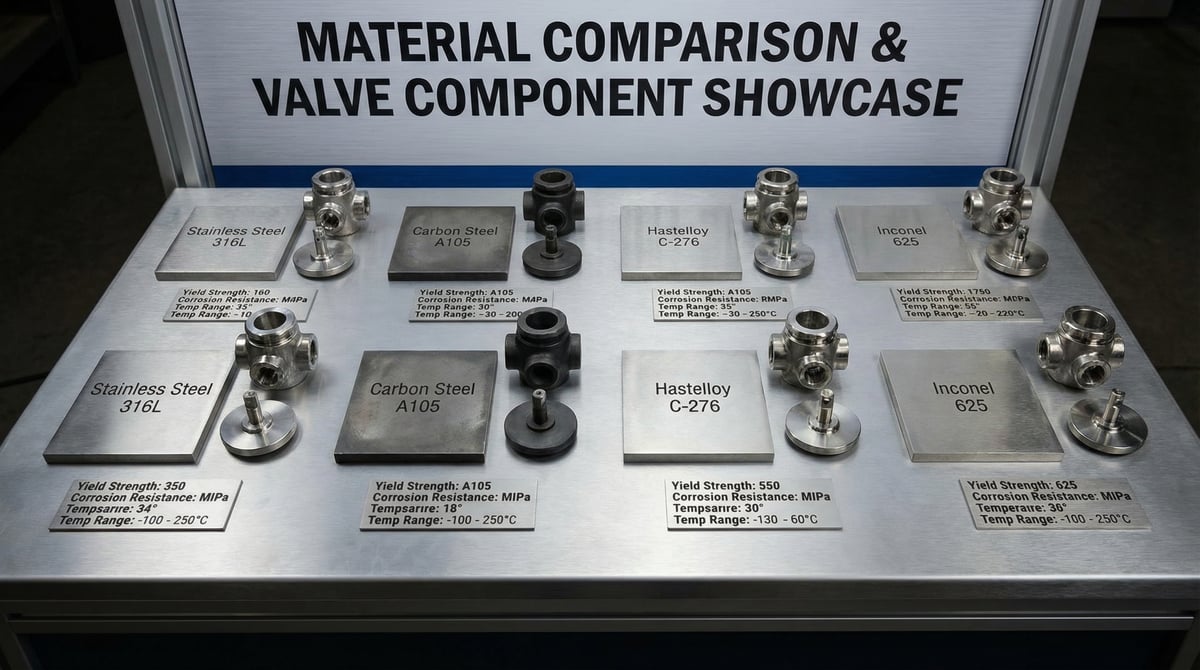
Carbon steel is the most economical valve material, suitable for non-corrosive services at moderate temperatures. Common grades include ASTM A216 WCB (cast) for general service -29°C to 425°C, ASTM A105 (forged) for flanges and fittings, and ASTM A350 LF2 for low-temperature service down to -46°C.
Advantages include low cost, good mechanical properties, and wide availability. Limitations include poor corrosion resistance (requires coating or lining), limited temperature range, and susceptibility to hydrogen embrittlement in sour gas service. Applications include water, air, and steam service, hydrocarbon service (non-sour), and general industrial processes.
Stainless Steel
Stainless steel offers excellent corrosion resistance through chromium oxide passive film formation. Type 304 (18% Cr, 8% Ni) is economical for general corrosion resistance, suitable for food, beverage, and pharmaceutical applications, and has a temperature range of -196°C to 800°C. However, it has limited chloride resistance and is susceptible to stress corrosion cracking.
Type 316 (18% Cr, 10% Ni, 2% Mo) provides superior chloride resistance, is standard for marine and coastal environments, and is used in chemical processing and pulp/paper industries. Type 316L (low carbon) prevents sensitization during welding and is required for pharmaceutical and food applications.
Duplex stainless steels (22% Cr, 5% Ni, 3% Mo) offer high strength (twice that of 316), excellent chloride stress corrosion cracking resistance, and good resistance to pitting and crevice corrosion. Super duplex grades (25% Cr, 7% Ni, 4% Mo) are used in offshore oil and gas, seawater systems, and chemical processing.
Exotic Alloys
Hastelloy (nickel-chromium-molybdenum alloys) provides excellent resistance to acids (HCl, H2SO4), high-temperature oxidation, and stress corrosion cracking. Common grades include Hastelloy C-276 for chemical processing and Hastelloy B-3 for hydrochloric acid service.
Monel (nickel-copper alloys) offers excellent resistance to hydrofluoric acid, seawater and brine, and reducing environments. Monel 400 is used in chemical processing and marine applications.
Inconel (nickel-chromium alloys) excels in high-temperature oxidation resistance (up to 1100°C), creep resistance, and thermal fatigue resistance. Inconel 625 is used in aerospace and gas turbines, while Inconel 718 serves high-temperature structural applications.
Titanium provides excellent corrosion resistance in oxidizing environments, high strength-to-weight ratio, and immunity to chloride stress corrosion cracking. It is used in seawater service, chemical processing (chlorine, chlorides), and aerospace applications.
Temperature Considerations
Low-temperature service (below -29°C) requires materials that maintain ductility and toughness. Options include ASTM A350 LF2 carbon steel (to -46°C), stainless steel 304/316 (to -196°C), and aluminum bronze (to -200°C). Impact testing per ASME Section VIII is required to verify toughness.
High-temperature service (above 425°C) demands creep-resistant materials. Chrome-moly steels (F22, F91) serve temperatures to 650°C, austenitic stainless steels (F316H, F321H) work to 800°C, and nickel alloys (Inconel, Hastelloy) handle temperatures above 800°C. Time-dependent properties (creep, stress rupture) govern design at high temperatures.
Corrosion Mechanisms
Uniform corrosion causes general metal loss across surfaces, predictable through corrosion rate data, and is controlled by material selection and protective coatings. Pitting corrosion creates localized deep holes, is caused by chlorides and stagnant conditions, and is prevented by molybdenum-containing alloys (316, duplex).
Stress corrosion cracking (SCC) results from combined stress and corrosive environment. Chloride SCC affects austenitic stainless steels and is prevented by duplex stainless steel or nickel alloys. Hydrogen embrittlement occurs in high-strength steels in sour gas (H2S) service and requires NACE MR0175 compliant materials.
Material Selection Process
Follow a systematic approach: identify process conditions (fluid type, temperature, pressure, pH), evaluate corrosion mechanisms and rates, consider mechanical property requirements (strength, toughness, hardness), assess fabrication and welding requirements, and analyze lifecycle cost (initial cost, maintenance, replacement).
Consult corrosion data sources including NACE corrosion data survey, manufacturer corrosion guides, and industry experience databases. Conduct corrosion testing for critical or unusual services through coupon testing, electrochemical testing, and pilot plant trials.
Trim Materials
Valve trim (plug, seat, stem) often requires different materials than the body. Hardened materials resist erosion and wear, including stellite (cobalt-chromium alloy), tungsten carbide, and ceramic coatings. Soft seats provide better sealing with PTFE, reinforced PTFE, and elastomers (Viton, EPDM, Buna-N). Match trim materials to body materials to prevent galvanic corrosion.
For expert material selection guidance and corrosion consulting, contact ControlValv's materials engineering team.